

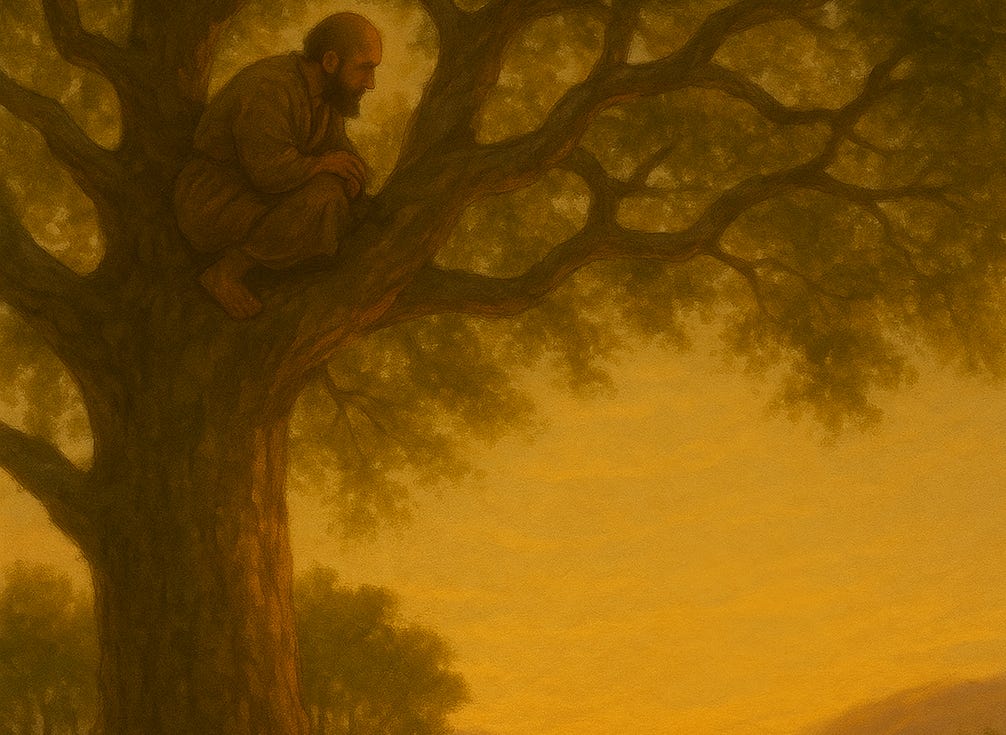
Zac was a thief, a fraud, and a broken man. One of Jericho’s most corrupt extortionists. He was wanting in character and short in stature. Known throughout Jericho for all the wrong reasons, he longed to rid himself of his vile nature.
A day in Jericho
35 As Jesus approached Jericho, a blind man was sitting by the roadside begging. 36 When he heard the crowd going by, he asked what was happening. 37 They told him, “Jesus of Nazareth is passing by.” (Luke 18:35 - 37)
Jesus entered Jericho and was passing through. 2 A man was there by the name of Zacchaeus; he was a chief tax collector and was wealthy. (Luke 19:1 - 2)
Bartimaeus and Zacchaeus shared more than most people realise. Neither could see Jesus. One was blinded by darkness; the other by the crowd. Both were despised. Both were helpless. Both desperately needed mercy.
Jesus met both men on his mission to Jericho. A chapter before Luke 19, where Jesus met Zacchaeus, was Bartimaeus begging for alms. Bullied by the people, he refused to stay quiet and lay hold of the redeemer. Zac was by the corner, waiting in the next chapter, trusting that his struggle would end. He, too, was a recipient of constant ridicule, though deserving in many people's opinions. He was a bad man. He fattened himself on other people’s sweat.
He quietly loathed the man he had become. He was addicted to the pleasures of sin and could not cure his own disease (who can). He heard how God had visited Bartimaeus, so he waited patiently, trusting the divine for a new chapter. Jesus was not yet finished making the best of the condemned. After he was done with Bartimaeus, he gave Zac a new chapter. Zac took it.
The Opium of Religion
Zac had no chance to meet Jesus by the standards of man. Same with Bartimaeus. He had no scent of religion. He seldom prayed and held no position in the synagogue. There was nothing pious about him; a man numbered with the transgressors. Whenever the Pharisees with their religious regalia and phylacteries walked by, Zac took the other road. Their righteousness was written on them, yet they possess nothing of Christ’s. Jesus gave a parable to address Zac’s situation and the religious crowd before meeting him in the next chapter. Yet they failed to see themselves in the parable, for they are forgetful listeners.
9 To some who were confident of their own righteousness and looked down on everyone else, Jesus told this parable: 10 “Two men went up to the temple to pray, one a Pharisee and the other a tax collector. 11 The Pharisee stood by himself and prayed: ‘God, I thank you that I am not like other people—robbers, evildoers, adulterers—or even like this tax collector. 12 I fast twice a week and give a tenth of all I get.’
13 “But the tax collector stood at a distance. He would not even look up to heaven, but beat his breast and said, ‘God, have mercy on me, a sinner.’
14 “I tell you that this man, rather than the other, went home justified before God... (Luke 18)
There is a cloud of religious folks in the church today who come to Christ for various reasons other than salvation from sin. Some came for the bread and some for the miracles. They need a breakthrough in their finances, so they come to Jesus. Some want to settle down, get a good husband or wife, so they show up. Some, like the Pharisees, see religion as a tool of control and manipulation. Others even need Jesus to make them bigger than their neighbours. They need Jesus to get ahead in life. It’s of no use to argue that the worst of humankind are in the church and religious places. The result doesn’t say otherwise. And why not? Something in them seeks deliverance, but they settle for the crumbs when they come to Christ. There is a crop of tongue-speaking people who bring no transformation to society: the “bless you” generation. Religious activity without repentance produces nothing but polished sinners. Churches may be full, prayers loud, and lips fluent in heavenly language, yet hearts remain strangers to Christ. Religion can imitate holiness without ever producing it. Zac and Bartimaeus found themselves in the midst of this crowd, but their faith kept them alive.
A brand plucked from the fire
Jesus was different, and Zac was paying attention. In his observation, he must have learned that Christ turned no one away. He wanted all to be saved.
But the crowd would not let Zac access Jesus. They blocked the way to eternal life, but they themselves would not go in. They occupy leadership positions, lead worship, and serve in the vineyard without a relationship with the Lord of the vineyard. Zac has to go beyond the religious crowd to access Jesus. For … unless his righteousness surpasses that of the Pharisees and the teachers of the law, he will certainly not enter the kingdom of heaven. When Jesus reached the spot (Zac climbed the tree), he looked up and said to him, “Zacchaeus, come down immediately. I must stay at your house today.” 6 So he came down at once and welcomed him gladly. 7 All the people saw this and began to mutter, “He has gone to be the guest of a sinner.” The religious crowd considered themselves saints as they called Zac a sinner. Sure, Zac was a sinner, more reason he wanted to meet the saviour. He was a tax collector. Wrong. He was a chief tax collector, an experienced sinner.
The pure joy of encountering Jesus cannot be explained. A gift no one can fabricate. When one encounters him, the world completely diminishes into nothingness. No amount of worldly riches or amusement can hold the heart set free. Zac’s response to Jesus revealed it all. “…Zacchaeus stood up and said to the Lord, “Look, Lord! Here and now I give half of my possessions to the poor, and if I have cheated anybody out of anything, I will pay back four times the amount.” A chapter before meeting Zac, Jesus met a very rich ruler who walked away sad because Jesus had asked him to sell all he had, give to the poor and follow him. He could not let go of his riches. Riches were never the problem. The problem was that Jesus was not yet his treasure.
To understand how rich he was, he gave out half his massive fortune, and still had enough to give to everyone he cheated four times what he defrauded them of. Jesus was not impressed by the amount Zacchaeus gave, but by the heart, like Abraham's, that had finally found a greater treasure. Jesus said to him, “Today salvation has come to this house, because this man, too, is a son of Abraham. 10 For the Son of Man came to seek and to save the lost.” Zac left the world behind and followed Jesus, truly, a brand plucked from the fire.
Anyone can escape the edge of the sword if they believe in the Lord Jesus. There is no sinner beyond the reach of the Saviour. The devil whispers that mercy has limits, that grace eventually runs dry, and that some stains are too deep to be washed away. Zacchaeus stands forever as God's answer to that lie. A chief tax collector climbed a tree in shame and came down as a son of Abraham. Beneath those boughs, he found not condemnation, but mercy. The same Christ still passes by, still calls sinners by name, and still delights to seek and save the lost.
Zac found mercy beneath the branches of a sycamore, but that mercy flowed from another tree still to come, the cross upon which Christ would bear the curse of sinners. The branches sheltered him for a moment, but the cross secured our salvation forever.
Listen to audio deep dive.
